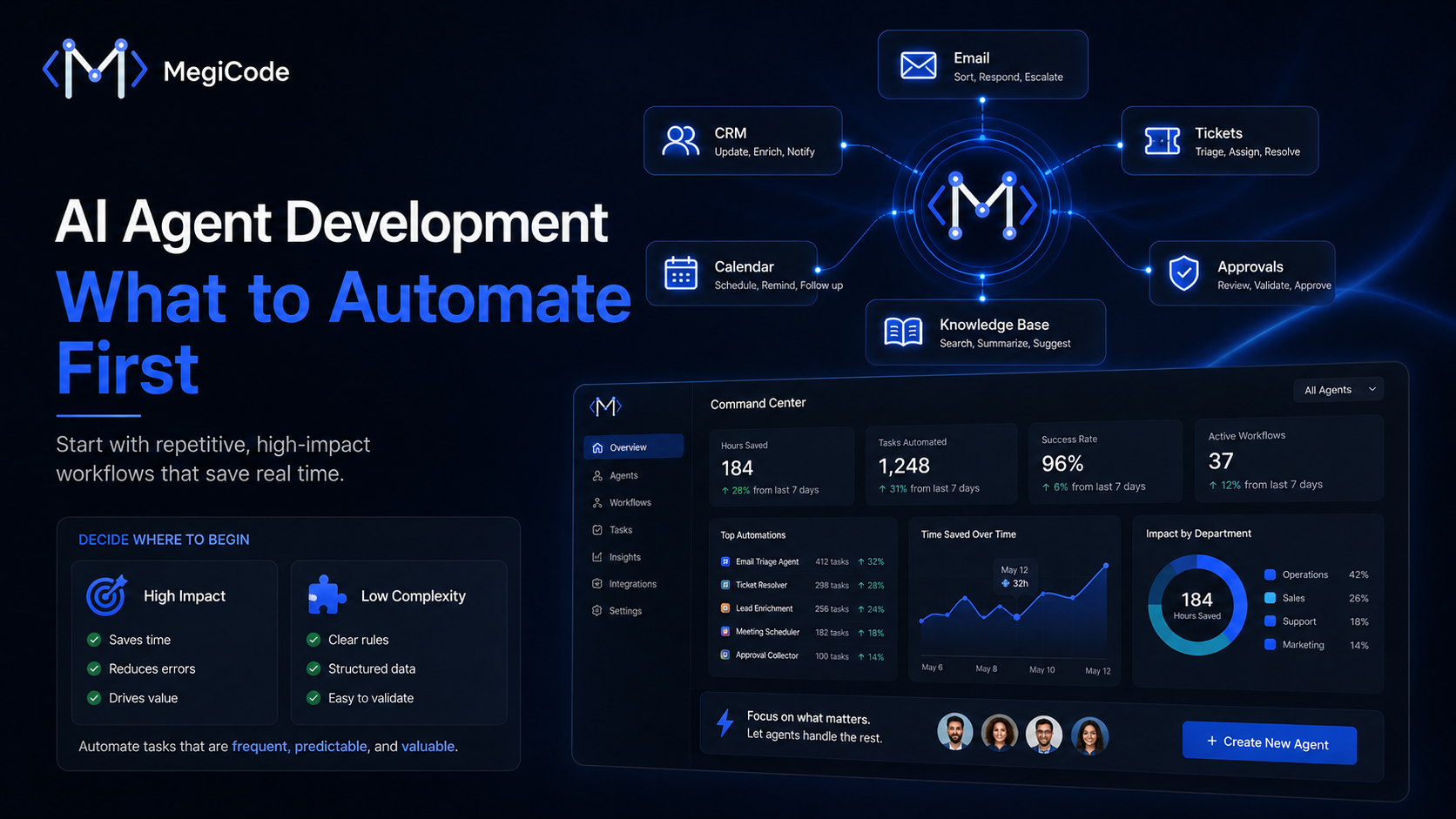
Executive takeaway: Many businesses invest in complex, multi-agent systems before proving the value of a single automated workflow. The most successful approach is to implement a single, high-ROI autonomous workflow (like lead triaging or document parsing) that operates within safe, supervised boundaries before scaling.
Megicode builds custom software, AI agent networks, and business automation systems that help companies eliminate manual admin work. This guide outlines how to audit your daily operations and choose the right first workflow for AI agent development.
What is an AI Agent?
Unlike traditional rule-based software or standard chatbots that simply respond to triggers, an AI agent (often referred to as an ai intelligent agent) is designed to accomplish a specific goal autonomously. It can:
- Analyze context: Read emails, documents, or databases and understand user intent.
- Make decisions: Determine the next best action based on business logic.
- Execute tools: Call APIs, write database records, generate invoices, or send messages.
For example, instead of a receptionist reading and routing every email inquiry, an AI agent can read incoming emails, query your CRM to check if the client is new or existing, classify the request, and draft a personalized response or assign it to the correct team member.
The Matrix: What to Automate First
To prevent wasting budget on "AI theater," rank your potential automation projects by Complexity and Business Value.
| Target Workflow | Business Value | Complexity | Feasibility / Recommendation |
|---|---|---|---|
| Lead Classification & Routing | High | Low | Build First: Safe, high ROI, operates via API. |
| Document Data Extraction | High | Low | Build First: PDF/contract parsing saves hours of manual entry. |
| FAQ Support Agent (RAG) | Medium | Medium | Build Next: Requires a structured company knowledge base. |
| End-to-End Clinic Booking | High | Medium | Build Next: Syncs patient calendars and checks clinician rules. |
| Fully Autonomous Sales Agent | High | Very High | Defer: High risk of hallucination; keep a human in the loop. |
3 High-ROI AI Agent Use Cases for Service Businesses
Modern service businesses, clinics, and startups can leverage AI agent development in three high-impact areas:
1. Inbound Lead Triaging and Auto-Response
An AI agent monitors your contact forms and emails. Within minutes of a lead submitting a request, the agent analyzes the message, scores the lead based on your qualification criteria, writes the lead details to your CRM (like HubSpot or Salesforce), and drafts a tailored follow-up email containing a calendar link.
2. Intelligent Document Processing
If your business processes hundreds of PDFs, invoices, contracts, or lab reports, a document parsing agent can read the files, extract specific data fields (like patient names, treatment codes, or billing figures), and enter the structured data directly into your database.
3. Customer Service Copilot
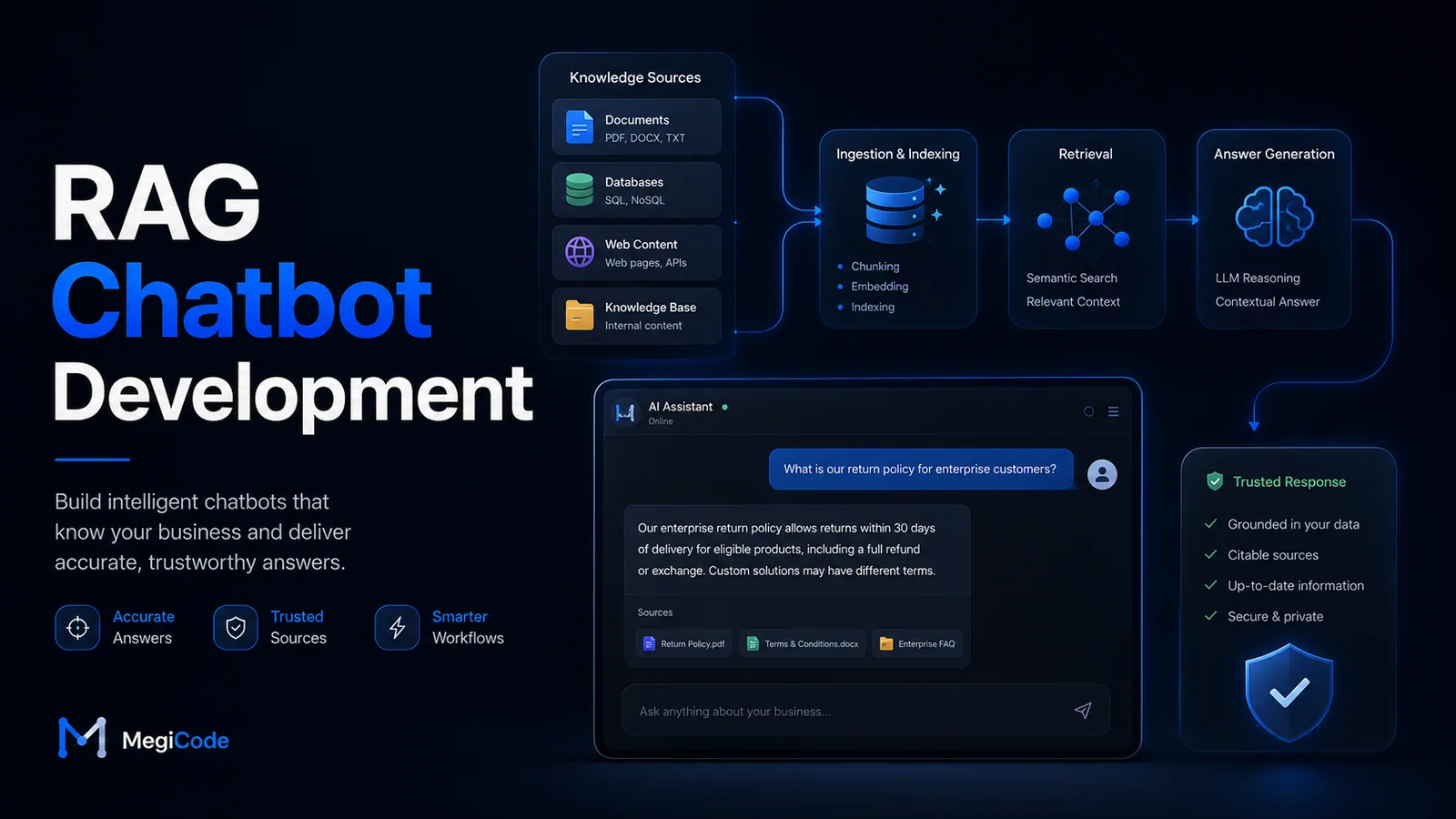
Instead of letting an AI agent speak directly to customers unsupervised, build a "Copilot." When a customer submits a support ticket, the agent queries your knowledge base (using RAG) and drafts a response for your human support staff to review and approve. This speeds up response times by 80% while ensuring 100% accuracy.
The Megicode Approach to AI Automation
At Megicode, we believe in building practical, production-ready AI systems. We focus on:
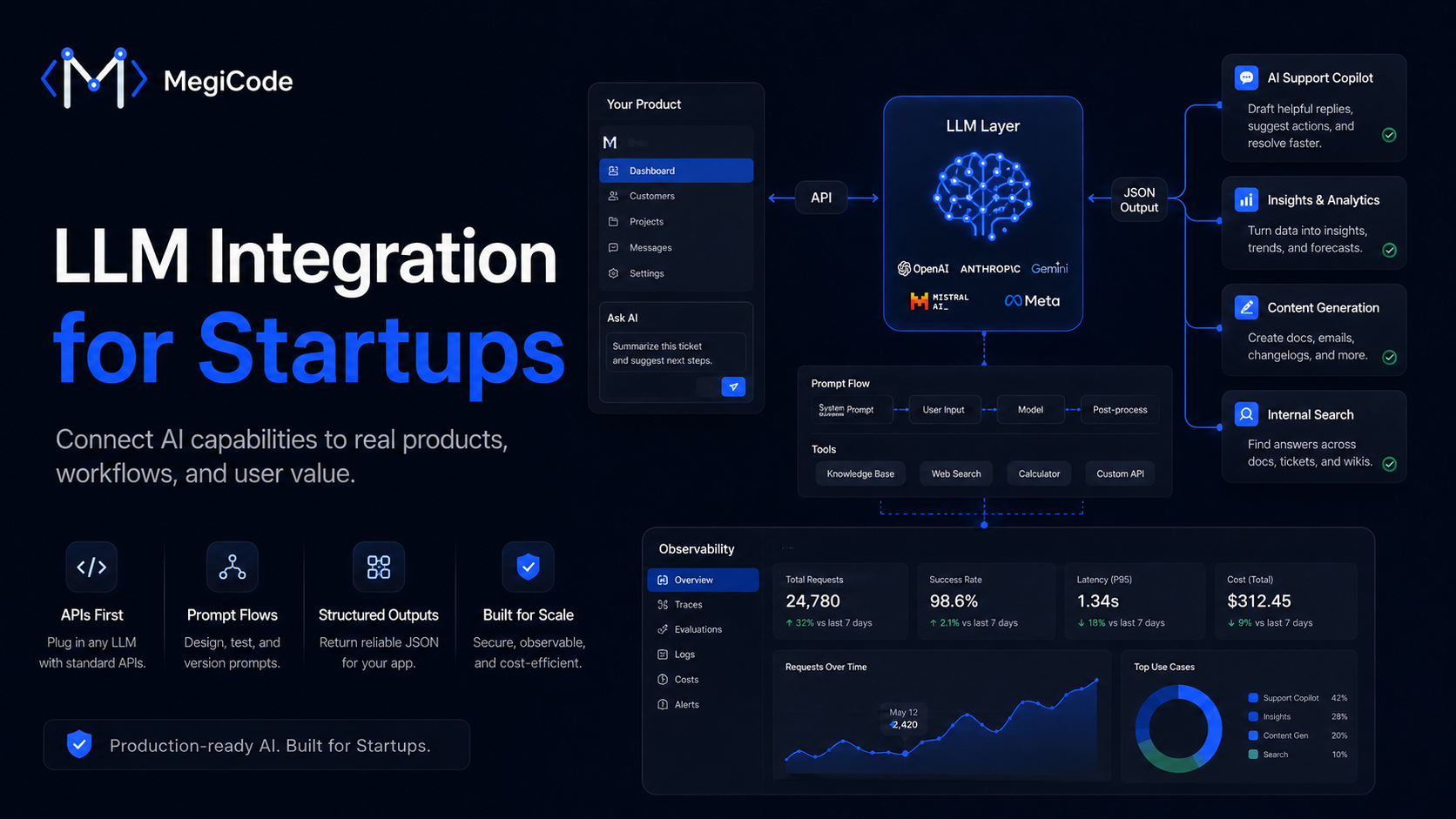
- System Integration: Connecting LLMs (like OpenAI GPT-4o or Claude 3.5 Sonnet) directly with your existing software stack via custom APIs or integration engines (like n8n and Zapier).
- Human-in-the-Loop (HITL): Designing dashboards where team members review and approve agent actions before they affect customers.
- Data Security: Enforcing strict data governance policies so your proprietary business data is never used to train public models.
Final Recommendation
Don't build AI for the sake of technology. Find the most repetitive, time-consuming text-based workflow in your business and automate it first.
Megicode can audit your workflows, build custom AI agents, and integrate them into your systems.
CTA: Schedule an AI Automation Consultation with Megicode to map out your first automation project.
Frequently asked questions
The cost depends on complexity. A simple document parsing agent or lead router can be deployed quickly, while a custom multi-agent workflow integrated into custom databases requires a larger development scope.
Large Language Models can occasionally hallucinate. We mitigate this risk by building strict prompts, providing structured schemas (using JSON mode), and implementing human-in-the-loop review screens for critical operations.
Rarely. For 95% of business use cases, leveraging existing models (like GPT-4o or Claude) via APIs combined with custom prompts and Retrieval-Augmented Generation (RAG) is more cost-effective and flexible.